

Eva Vinyets, participant in the Volunteer Programme at the RMF, talks about her experience in Senegal.
“He who must travel happily must travel light.”
Antoine de Saint-Exupéry, quote from The Little Prince.
“Time goes by so fast. It has been over a month since I returned from Senegal, a trip that put my life on hold for two weeks. Once again at home, looking at the photographs, turning over the memories and trying to organise my thoughts, I reflect on the trip.
At the beginning of this year, when the Ramon Molinas Foundation offered me the opportunity of collaborating with Catalunya-Casamance, I had no idea of the impact that it would have on me. I remember when we talked about different educational and development projects that the organisation runs in Kafountine, a fishing village in the south of Senegal. One of the projects, and the one which stood out to me the most, was a project with talibé children. It was the first time that I had heard the word talibé. Doing some research, I read that they are children between 4 and 14 years old that are handed over by their parents – usually farmers with very little resources – to marabouts, teachers in Koranic schools. With the objective of constructing a care centre for talibé children and providing them with food, education and care to improve their quality of life, Catalunya-Casamance launched a project at the beginning of 2016 under the name ‘The talibés of Kafountine’. Sadly, this project was put on hold due to opposition to the law against child begging – passed by the Senegalese government last year – from powerful marabouts in the city of Santa Trouba.
The second project which we spoke about was the ‘Kafountine School’, where literacy classes are offered to adults in French, the official language of Senegal. They also offer Spanish and English classes, and are starting IT lessons. These classes, given by volunteers, are for local people that want to improve their professional opportunities. The organisation offers accommodation to volunteers that is also rented to tourists so the project is able to finance itself.
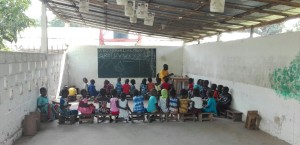 The third project, which I was able to collaborate with thanks to my experience in education, was the ‘Primary Schools’. The principal objective of the schools is to break the cycle of illiteracy that starts in infancy, providing schooling to the youngest children so that mothers are able to work and older children can attend school instead of having to stay at home to look after their younger siblings. The organisation has had a centre in the neighbourhood of Kabar since 2011, and a new centre under construction in the neighbourhood of Santossou.
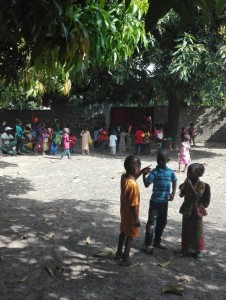 My days in Kafountine were full of personal discoveries. Every morning I travelled by bike to Kabar Primary School. On the journey I observed the local people, crossed the market, came to a small house where a group of women said hello to me, and took the path that led directly to the school. The children welcomed me with hugs and smiles. We started classes in the morning with songs, followed by activities prepared on the flow chart for each week. I was surprised at the abilities of the local teachers to speak in French, but also address each child in their own mother tongue (Diola, Mandinka, Wolof among others). I was also shocked by the interest the children had in my skin and straight hair. They loved to touch me, looking at me with open eyes, looking at every detail of my face. They pointed at my freckles and giggled every time I stuck out my tongue or tickled them. Little by little they learned my name and I got to know theirs. In the afternoon, after waiting for my colleagues to finish the adult classes, we went on excursions around the local area (to the botanical garden, the artisanal market, the beach and on walks). When night fell, we would stay at home talking and exchanging stories.
Now, with perspective, I value the experience in a hugely positive way and appreciate the opportunity provided to me by the RMF. I feel lucky. Seeing close up the work that Catalunya-Casamance does in Kafountine – providing work to local teachers at Primary Schools, promoting education in the youngest children and providing knowledge to adults to improve their futures – is truly inspiring”.