

6 of the 41 young people that enrolled on the RMF: Scholarship in English for Young Learners at the British Council talk about their positive experiences on the initiative.
Alex, Valeria, Fátima, María, Mareena and Swarup are 6 of the 41 young people who have been benefitting from the RMF: Scholarship in English for Young Learners at the British Council grants during the academic year 2015-2016. All of them agree that “it’s very important” to learn English in order to acquire the communicative skills to open doors in the future. However, the level of English of Spanish citizens is twenty-third in the global rankings, falling three places since 2014, according to the English Proficiency Index carried out by Education First.
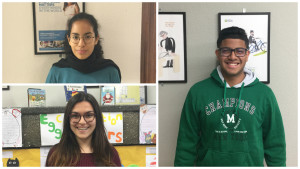
Valeria, above; María, below; y Alex, right.
The results of the study suggest that, in Spain, despite launching major initiatives such as the promotion of bilingualism in schools, young people “do not receive a good education at school age”, the vast majority reaching “intermediate” level at the end of secondary school. In addition, “at school, in English class, we are not speaking in English all the time”, explains Alex. This young man from L’Hospitalet de Llobregat highlights that the best thing about the programme created by the Ramon Molinas Foundation and the British Council is “being able to speak English throughout the whole class”.
The level of knowledge of English of the secondary level students contrasts with the demands of the labour market. Leading human resources consultants warn that between 70 and 80 per cent of job offers require candidates to be fluent in English. According to a report published by Ranstad, based on data from the Eurostat statistics office, suggests that eight out of ten job offers for middle management and directors state knowledge of the English language as an essential quality.
In spite of these facts, the six young people are aware of the advantages which come with learning English. “I want to study Chemistry”, says Valeria, 16 years old, who is set on continuing her training outside Spain after university. “Our school has explained to us that you are appreciated a lot more if you study a Master’s abroad, meaning that being able to understand and speak English is vital to me”. Although Valeria or Alex, who want to be a neurosurgeon and a psychiatrist, are both clear what they want to pursue, Mareena and Mary, both from Santa Coloma de Gramenet, are not sure where they want to direct their professional futures. However, they have no doubt that “English is a very important language which nowadays, you can use to communicate to the whole world, and will help you a lot professionally”.
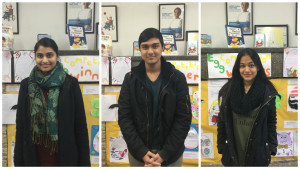
From left to right: Mareena, Swarup and Fátima.
The six young people, who have been taking part in the programme for a little more than a month, have noted an improvement in their communication skills. “I’ve noticed progress and I have more confidence in myself”, says Fátima, who is 17 years old. On the other hand, María points out that when she has to express herself in English, “I used to be really embarrassed and scared of making mistakes”. “With the British Council, if I make a mistake, it doesn’t matter. They correct me and help me to improve”, she comments. “I particularly enjoy the fact that we are learning vocabulary and expressions”, says Valeria. “In my case”, explains Fátima, “I especially appreciate the grammar”.
The RMF: Scholarship in English for Young Learners at the British Council with the collaboration of Government of Catalonia Department of Education promotes the continued education of advanced English with the objective of encouraging the social integration of young people who achieve academic excellence and have great ability, but also come from disadvantaged socioeconomic backgrounds. “I think that they should launch more initiatives like this”, states Swarup, 16 years old and from the Barcelona district Ciutat Vella. “Lots of people should improve their English, but financial difficulties mean they aren’t able to”, remarks Alex. Mareena states that “it’s a fantastic initiative”. “We won’t let this opportunity slip away and I think that more people should have it”, says María. Before walking into the classroom, she finishes the interview expressing gratitude for the initiative: “Thank you for the opportunity”.