

The three winners presented projects on artificial vision software for the University of Princeton, an app which accompanies parents during the upbringing of their newborns and an innovative programme which monitors breathing in a non-invasive way.
Monitoring of mice limbs in optogenetic experiments by Pere Parés; My wee app: Design and development of a mobile application for the upbringing of babies, by María Fernández and Automatic segmentation of breathing based on acoustic recording, by Juan Alberto Castro have won first prize in the categories of Information Technology, Multimedia and Security and Telecommunication respectively at the second UOC-RMF Prizes award ceremony. The prizes, organised by the Ramon Molinas Foundation and the Open University of Catalonia, were awarded to the three best final projects by students of Information Technology, Multimedia and Telecommunication at the UOC. The winners will receive a cheque for 3,000 euros alongside the recognition of having completed the best piece of work of their academic year and the acknowledgement of the IT sector.
Pere Parés, winner of the UOC-RMF Prize in the category of Information Technology for suggesting a solution to the Princeton Neuroscience Institute
Monitoring of mice limbs in optogenetic experiments, by Pere Parés, has won the UOC-RMF Prize in the category of Information Technology. The project has resolved a difficulty experienced by a neuroscience research group at Princeton University. One of the lines of work at the research centre of the North American university is optogenetics, a combination of techniques from optics and genetics which help to control specific occurrences in certain cells with the precision in timing required to maintain the functioning rhythm of biological systems. This technique allows scientists to control the brain in a non-invasive manner, through the use of light, helping in the understanding of neurodegenerative disorders or to alleviate chronic pain.
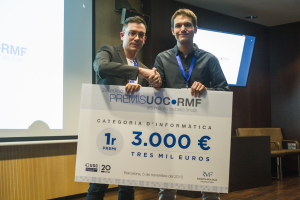
Albert Fabregat, finalised of the first UOC-RMF Prizes, awards the first prize in the Information Technology category to Pere Parés.
The University of Princeton is investigating this technology. By genetically modifying rodents so that their neuronal tissue is sensitive to light, scientists are able to interact with the rodents’ motor apparatus using laser techniques. Yet up until now, investigators at the North American university had not found a way of automatically measuring the stimuli applied. Pare Parés has provided them with artificial vision software capable of determining the position of the front and hind limbs of the mice at any time, without adding sensors of any kind, by utilising several video cameras in the test environment. The winner achieved this by incorporating a sequence of computer vision and artificial intelligence algorithms.
Pere Parés competed to win the category of Information Technology with Miguel Colom, whose project was entitled Analysis, improvement, and development of new firmware for the smart citizen kit ambient board.
María Fernández, winner of the UOC-RMF Prize in the category of Multimedia thanks to the creation of a mobile application which accompanies parents during the upbringing of their little ones
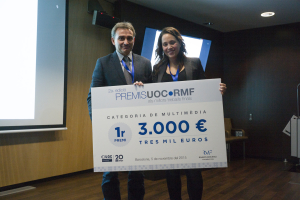
Josep Prieto, director of EIMT at the UOC, with María Fernández, winner of the Multimedia category.
My wee app: Design and development of a mobile application for the upbringing of babies, by María Fernández, has won the UOC-RMF Prize in the category of Multimedia. The winning project is a mobile application using Android technology which turns into an essential guide to accompany mothers and fathers during the upbringing of their babies. My wee app helps to monitor and manage the needs of a newborn: the application allows you to create different profiles for babies, free of charge, and to register the frequency of breastfeeding, nappy changing, sleeping pattern, baths, medicines and visits to the paediatrician. The application offers a smooth and intuitive interface and enables all the necessary functions to make the user experience as enjoyable as possible.
María Fernández competed to win the category of Multimedia with Roger Sales’ project RenalClick: A system for the self-management of chronic renal disease.
Juan Alberto Castro, winner of the UOC-RMF Prize in Security and Telecommunication thanks to the creation of an innovative programme which monitors respiration in a non-invasive way
Automatic segmentation of breathing based on acoustic recording, by Juan Alberto Castro has been awarded the winning project in the category of Security and Telecommunication. The student from Barcelona presented a programme which identifies, in real time, the respiratory movements of inhalation and exhalation, buccal and nasal, through a microphone. The project is the result of an experimental research process which integrates two areas of signal processing and artificial intelligence. The finalist created a state machine, based on the time sequence of results of the classification method he developed. Tests have shown the percentage of positive identifications to be more than 93%.
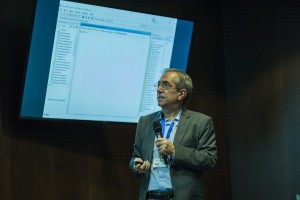
Juan Alberto Castro, winner of the Security and Telecommunication category.
The winning proposal has opened the door to non-invasive systems of monitoring breathing. The methodology devised by the finalist makes it possible to measure stress levels, detect apneas or to monitor the breathing of someone with asthma, with the prescription of a pulmonologist, in order to determine whether the user inhales and exhales only through the nose for example, among other medical uses.
The winner of the Security and Telecommunication category competed with José Alfonso Pérez and his project Demotic control with mobile devices.
The Palau Macaya, witness to the second awarding of the UOC-RMF Prizes
The six finalists presented their work at an event at the Palau Macaya in Barcelona. A panel made up of seven academics and professionals from the IT sector, including Josep Dueso, CEO and spokesperson of the Ramon Molinas Foundation, decided that the projects mentioned above are those deserving of the three first prizes of 3,000 euros. However, the three second prizes made the panel’s decision very difficult. Miguel Colom, Roger Sales and José Alfonso Pérez presented high quality work and met with applause from the 140 attendees of the award ceremony and an iPad Mini as thanks for their participation in the UOC-RMF Prizes.
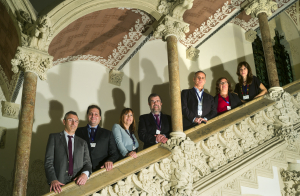
The members of the panel of the second awarding of the UOC-RMF Prizes, made up of professionals and academics from the IT sector.
Josep Dueso, CEO and spokesperson of the Ramon Molinas Foundation, has urged the 100 or so students who applied to be one of the six finalists to never lose heart. “Continue with the faith, hope, perseverance and determination with which you developed these projects”, he remarked. The representative of the Foundation also highlighted the importance of “encouraging ingenuity and the belief in young people, providing them with the necessary tools for them to develop to their full potential”. In addition, Josep Prieto, director of studies for Information Technology, Multimedia and Telecommunications at the UOC, took the opportunity to remember the founder of the Ramon Molinas Foundation. Prieto compared the profile of Ramon Molinas to Steve Jobs or Bill Gates. “The three of them have been great entrepreneurs in Information and Communication Technology who have given back a part of their profits to society”, he confirmed.
Moreover, the event was honoured with a presentation by Ramsés Gallego, international expert in data security system who urged attendees to “innovate without fear of failure”. Albert Fabregat, semi-finalist of the first UOC-RMF Prizes also participated in the event and recalled his experience at the awards the previous year. Despite not taking home first prize, Albert is certain that the UOC-RMF Prizes helped him to advance in his career. “It was a great experience. The UOC-RMF Prizes gave me an injection of self-esteem”, he stated. Albert Fabregat recently co-founded TimTul Technologies, a start-up which offers a complete communication platform to organisations. The second UOC-RMF Prizes award ceremony was conducted by the director and presenter of Catalonia Television’s Digital Generation, Lluís Marquina.
Links of interest:
Photos: Enrique Marco.