

The student from Palma in Majorca won the award for her design of an application of the traditional Majorcan almanac for mobile phones and tablets.
Parenòs-tic: Imagen y diseño gráfico de la aplicación móvil de un almanaque (Image and graphic design of the mobile application of an almanac), by Antònia Lorente Bibiloni, has won the first edition of the UOC-RMF Awards for the best final works by students from the Information Technology, Multimedia and Telecommunications programmes of the Open University of Catalonia. A panel composed of seven academics and professionals from the ICT sector, including Josep Dueso, RMF board member, considered that Ms Lorente’s work merited the first prize of €5,000.
The project of the winner, a student from the University Master’s Degree in Multimedia Applications, is an application for mobile phones, tablets and other mobile devices of the traditional Majorcan almanac which is published annually and which has been used by farmers for centuries. Parenòs-tic combines antiquity and modernity, tradition and new technologies in an application that contains astronomical data, meteorological forecasts and popular sayings and that can solve doubts such as: Is it a good period to plant carrots? Can I shear sheep? Is it a good time to cut back brambles? The application endeavours, in real time and in an easy and intuitive manner, to meet the needs of the primary sector and of the new wave of people practising domestic agriculture in their own homes. The winning project contributes to perpetuating the tradition of Majorcan agriculture.
The UOC-RMF Awards, organised by the Ramon Molinas Foundation and by the Open University of Catalonia, started with the aim of putting the spotlight on the final works of students from the Information Technology, Multimedia and Telecommunications programmes of the UOC. In this way, students come into contact with the professional sector of information and communication technology. “We want to facilitate students’ launch”, said Josep A. Planell, rector of the Open University of Catalonia, during his speech. Furthermore, Josep Dueso, board member of the Ramon Molinas Foundation, encouraged the finalists and the more than 100 students who presented an application to be candidates among the six finalists. “Keep working with the faith, eagerness and consistency with which you carried out these works”, he stated. The representative of the foundation also highlighted the importance of “believing in people and providing students with the necessary tools so that they can develop all their skills”.
Sergio León and Sergio Gómez, second and third place, respectively
Aplicación web para el control y la monitorización de una piscina (Web application to control and monitor swimming pools) by Sergio León Esquivel, was awarded second place. The project by the student from Barberá-del-Vallés in Catalonia, which was awarded €3,000, stemmed from the need to control a private swimming pool easily. In general, this process is carried out manually. Sergio León, a student from the Multimedia Degree devised and presented a web page that enables the user to compile swimming pool data in real time in order for it to be monitored on a browser, in such a way that the user can find out the current situation of the system through the Internet. PoolDiuno, which is the name of the application, enables the user to check the temperature, pH or condition of the pump that doses the chlorine in a simple and intuitive manner. Moreover, the platform facilitates remote interaction with the swimming pool so that hardware can be worked on without having to be physically present.
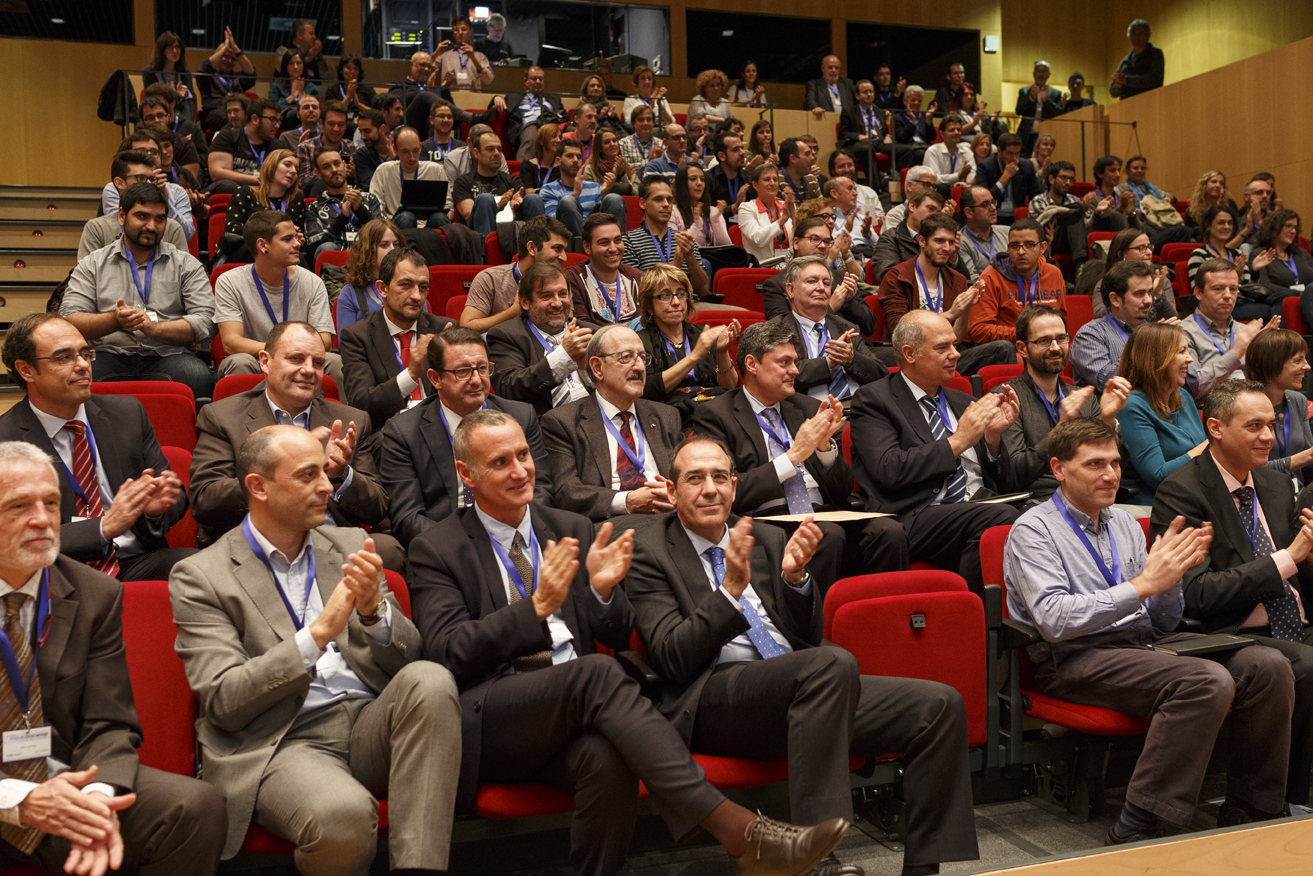
Approximately 200 people attended the first edition of the UOC-RMF Awards.
Sergio Gómez Espín, with Sistema de alarma y monitorización ambiental con gestión remota para entornos críticos (Alarm and environmental monitoring system with remote management for critical environments) was awarded third place and received €2,000. The project by the student from Badalona in Catalonia, who studies the speciality of Telematics in Technical Telecommunication Engineering, describes the design and development of an alarm and environmental monitoring system with remote management for critical environments or high availability environments. The critical or high availability environments —for example, surveillance of the temperature of main servers— are services that require exhaustive and permanent monitoring by staff. The device created by Sergio León regularly obtains the temperature recordings and processes them in accordance with the configuration parameters set by the user. The alarm system consists of the device sending an automatic warning email when the temperatures obtained are outside the safety margins. Likewise, the system has an additional application that receives the temperature data of the device and provides the configuration parameters of the system. The user can configure the device remotely and view the temperature data in real time.
Albert Fabregat, María José Moreno and Esteban Román, finalists
The other three finalists, Albert Fabregat, María José Moreno and Esteban Román, did not facilitate the panel’s task. Albert Fabregat Hernando, a student from the Degree in Computer Management, presented World of Wars, an action videogame for Android platforms which emulates the former arcade games. World of Wars can be downloaded free of charge on Google Play.
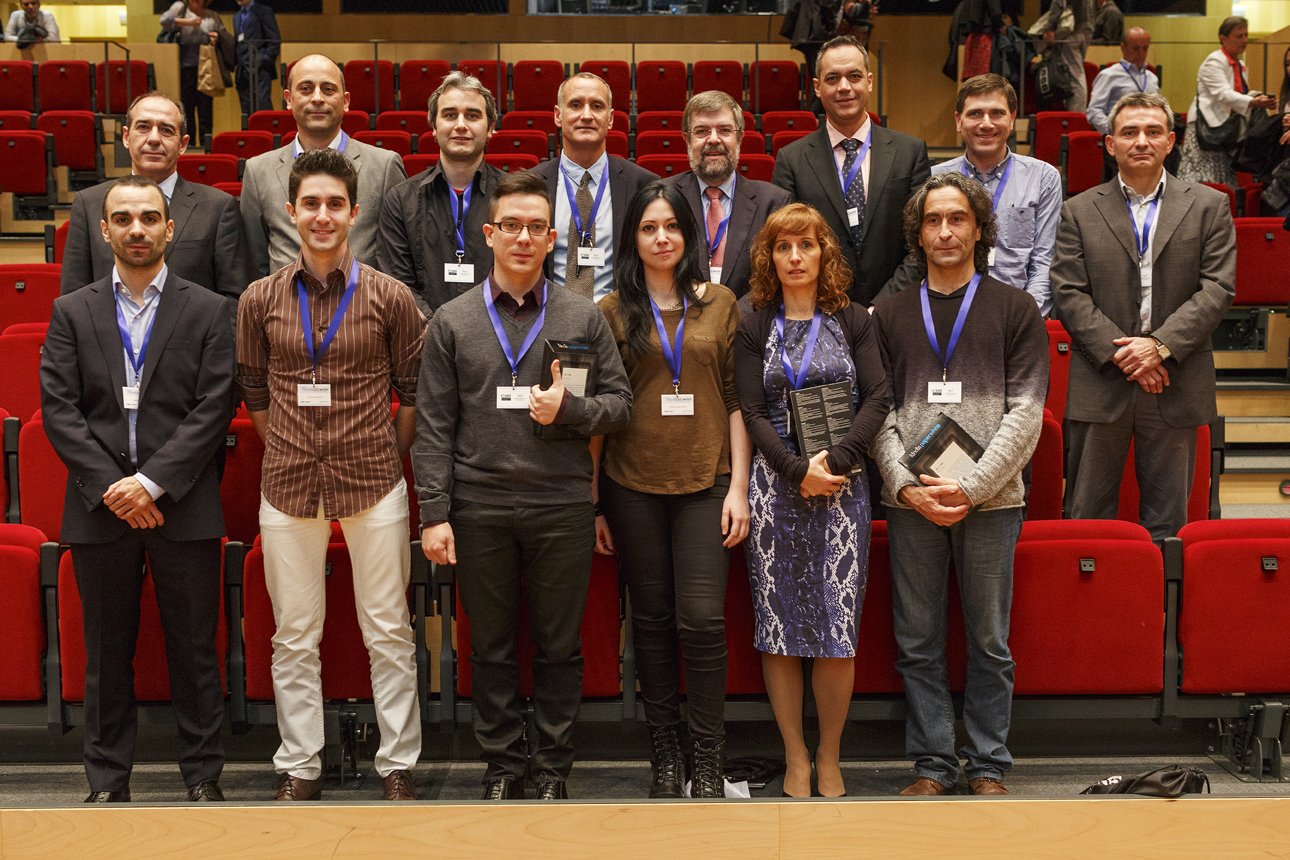
Members of the panel, in the upper part of the photo, and the six finalists of the UOC-RMF Awards.
Furthermore, María José Moreno de Frutos presented Verificación y gestión de facturas electrónicas en un teléfono Android (Checking and management of electronic invoices on an Android telephone). The student from the Inter-university Master’s Degree in Information and Telecommunication Technology Security developed an application for telephones with the Android technology that helps users to manage their electronic invoices with the Facturae format. The application validates and stores information from the electronic invoices loaded onto the mobile using Bluetooth. The invoices are classified according to the categories defined by the user, and can be consulted according to the convenient item (category, issuer or date). In addition, the application can be used to send the stored electronic invoices by email and to make back-up copies.
Lastly, Esteban Román Castellanos presented La ciudad en el contexto de la Internet de las cosas (The city in the context of the Internet of things). The project is part of the development of the smart city of Barcelona. The student from the University Master’s Degree in Free Software described the technology via which the sensors positioned in all types of devices can communicate with processes from the real world to provide services that improve the habitability and sustainability of cities.
The first edition of the UOC-RMF Awards also included the conference De la universidad al mundo laboral: good news, bad news (From university to the professional world: good news, bad news), chaired by José Luis Solla. The 200 attendees, the majority of whom were students from the UOC, listened attentively to the information and communication technologies expert, as he explained the transition from the academic world to the professional world in the current context. In addition, Josep Prieto, director of Information, Multimedia and Telecommunication Studies at the UOC also spoke at the event, underlining the importance of the establishment of the UOC-RMF Awards.
Photos: Enrique Marco.