

The winners presented a paintbrush that allows you to interact with reality in real time and in a virtual environment; an educational, domestic robot based on open-source software designed to bring robots into schools; and a laser system that exterminates the parasites that are contributing to the extinction of bees.
PaintXYZ: Painting reality through virtual worlds by Iván Martí; Makit Humbot S: Open-source robot based on Arduino and printed in 3D, by Cristóbal Selma, and Varroa Laser Removal System, by Ángel Manuel López, have won first prize in the categories of ‘best business project’, ‘best project with social impact’ and ‘best research project of academic excellence’ in the third year of the UOC-RMF Prizes.
The winners, organised by the Ramon Molinas Foundation and the Open University of Catalonia, have recognised the three best projects among the students of Information Technology, Multimedia and Telecommunication in the UOC.
The UOC-RMF Prizes encourage entrepreneurship in technology and science with the aim of inspiring and helping to launch good ideas which help to improve society. The winners have received a cheque for 3,000 euros and the recognition of having completed the best projects in their academic year. However, the prizes haven’t just recognised the projects of the six finalists. This year, the Ramon Molinas Foundation and the Open University of Catalonia will provide the authors of the 27 best projects, including the six finalists, with the opportunity to make their projects a reality.
Ivan Martí, winner of the UOC-RMF Prize in the ‘best business Project’ category for creating a paintbrush that allows the user to interact with reality in real time and in a virtual environment

Jordi Llonch, Managing Director of Sharing Academy, awarding first price in the category of ‘best business project’ to Ivan Martí.
PaintXYZ: Painting reality through virtual worlds, by Ivan Martí from Reus, has won the UOC-RMF Prize in the category of ‘best business project’. PaintXYZ is a low-cost system which allows the user to interact with reality in real time and in a virtual environment. By utilising a paintbrush costing between 25 and 50 euros, users can paint realist, construct superimposed three-dimensional objects or apply texture through archived images through a smartphone. The device, which is available in prototype, allows you to visualise, save, locate and share any creation. The system communicates through a Bluetooth connection and allows you to work in both the virtual world and augmented reality. PaintXYZ users can move throughout the virtual environment through interpreting mobile sensors, which allow you to make short-distance movements with the direction of the head or by moving the physical brush and its buttons. The objective of the device is to provide a set of tools that will develop virtual expression which combines reality and the digital worlds.
Ivan Martí competed to win the category of ‘best business project’ against Business and development plan for a SaaS based Restaurant Menu System by Iñaki Bigatà.
Cristóbal Selma, winner of the UOC-RMF Prize in the category of ‘best project with social impact’, with his creation of an educational, domestic robot based on open-source software designed to bring robots into schools

Xavier Cortés, director of the Ramon Molinas Foundation, with Cristóbal Selma, winner of the ‘best project with social impact’ category.
Makit Humbot S: Open-source robot based on Arduino and printed in 3D by Cristóbal Selma from L’Hospitalet, has won the UOC-RMF Prize in the category of ‘best project with social impact’. Makit Humbot S is an educational and domestic robot based on open-source software which was created with the aim of bringing robots into secondary schools. The initiative would allow students in schools and educational centres to get involved in the fields of mechanics, electronics, programming and robotics, and to understand the functioning of a number of devices and programmes that are often used in strategic thinking and mathematical reasoning. Makit Humbot S would be available to schools who would have access to, for free, the documentation, design process, the selection of components, the printing process of pieces with a 3D printer, mounting instructions and the guidelines of automated programming through the website www.makitpro.com. The robot, created by a Valencian settled in l’Hospitalet de l’Infant, is created completely with open code which means that anyone with the necessary means can construct their own Makit S easily and affordably.
Cristóbal Selma competed to win the category of ‘best project with social impact’ against Lluís Tartera with his project Web application for the epidemiological control of tuberculosis (TBC) in Manhiça, Mozambique.
Ángel Manuel López, winner of the UOC-RMF Prize in the ‘best research project of academic excellence’ category for creating a laser which exterminates the parasites which are contributing to the extinction of bees

Josep Prieto, director of the EIMT programme at UOC, with Ángel Manuel López, winner of the ‘best research project of academic excellence’ category.
The Varroa Laser Removal System by Ángel Manuel López is the winner of the ‘best research project of academic excellence’ category. Bees, which play an essential part in the pollination of flowering vegetable species, are under threat. According to a report by the International Union for Conservation of Nature (UICN), around a tenth of the bee populations in Europe are facing extinction and the status of over half is completely unknown.
One of the main causes of mortality within bee colonies is the varroa, a mite which measures two millimetres across and feeds off the haemolymph of bees, the internal circulatory system equivalent to the circulatory system of blood in vertebrates. The project, available in prototype, localises and eliminates external parasites on the bees using a laser, thus it means reducing or eliminating altogether the use of pharmaceuticals and chemicals to treat infected bee colonies. Reducing the mortality rate caused by the varroa mite means that the bees can recuperate from infection in a less invasive way.
The winning Project, created by a resident of Murcia living in the United Kingdom, competed to win the category of ‘best research project of academic excellence’ against Eduard Marcel González’s project, Emotion recognition system in speech based on voice signal parameterisation.
The Palau Macaya, the stage for the third UOC-RMF Prizes
The six finalists presented their projects at an event held at Palau Macaya in Barcelona. A panel made up of seven academics and professionals linked to the entrepreneurship and IT sectors chose who deserved to be the winners from projects mentioned above. However, the three runners up did not make the decision easy. Iñaki Bigatà, Lluís Tartera and Eduard Marcel González presented high quality projects. They were applauded by the gala’s 140 attendees and given a gift of thanks for their participation in the UOC-RMF Prizes.
Xavier Cortés, Director of the Ramon Molinas Foundation, has highlighted the role of the Foundation. “Modestly, we want to play a significant part in the process of social transformation”. “The founder of the organisation, Ramon Molinas, has entrusted us with a mission: to promote research and technology as tools of progress, shared improvement and to improve the quality of life of disadvantaged groups”, he stated. Cortés highlighted the quality of the projects presented and urged the 60 candidates that competed to be one of the six finalists to never give up. “Consider the RMF your travelling companion to keep helping you in your work and research”, he said.
In addition, Josep Prieto, director of studies of the Information Technology, Multimedia and Communications course at UOC, took advantage of the occasion to remember the founder of the Ramon Molinas Foundation, and reminding the audience of his achievements as a great entrepreneur and how he spotted many chances to innovate.
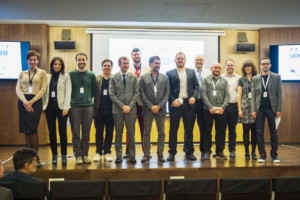
The panel and finalists at the third UOC-RMF Prizes awards ceremony.
The event included a presentation by Jordi Llonch, founder and Managing Director of Sharing Academy, who talked about the challenges of being an entrepreneur from his experience. Llonch was an aspiring finalist in the first UOC-RMF Prizes with the project that he currently manages, a peer-to-peer marketplace which allows students to receive and offer private classes to students at the same university, awarded the ‘Best App’ at the 2016 Mobile Premier Awards.
The third UOC-RMF Prizes award ceremony was conducted by director and presenter of Catalonia Television’s Digital Generation Lluís Marquina, with a guest appearance by comedian Víctor Parrado, who sprinkled the ceremony with his viral positive attitude and humour.
Links of interest:
Photographs: Enrique Marco.