

The study will contribute towards a comprehensive approach towards people who suffer from these disorder through a new interface, with the objective of improving their quality of life.
The Ramon Molinas Foundation has signed a collaborative agreement with The Foundation for Biomedical Research at the Niño Jesús University Children’s Hospital in Madrid and Living with Spasticity (Convives con Espasticidad) in order to initiate a study that could improve the functionality of the head and torso in children with cerebral palsy thanks to a new interface. RMF is sponsoring the study which originates from technology developed for the National Spanish Council Research into the Sciences Bioengineering Group (GBIO-CSIC). It centres around an inertial measurement device integrating a tri-dimensional accelerometer, a gyroscope and a 3D magnetometer located on the arm of a pair of glasses. The mechanism is capable of measuring the acceleration caused by movement and gravity, the angular velocity and the earth’s magnetic field.
The study’s participants, children between 4 and 17 years old diagnosed with cerebral palsy and have difficulties with functionality of the upper body, will control a video game through the movements of their head thanks to the interface discussed previously. The interface automatically collects kinematic parameters like orientation, angular velocity and acceleration in order to determine possible improvement of the participants. If this is the case, it would open up new methods to achieve greater functionality in these children.
Currently, the majority of research on children with cerebral palsy is centered around the evaluation and treatment of the lower extremities, considered the most important element for the mobility and independence of minors. This project hopes to amplify the comprehensive approach towards children who suffer from this disorder by providing systematic training. Xavier Cortés, Director of the Ramon Molinas Foundation, has assured that he “has full trust in the project and in the team developing it”. “The RMF promotes the progress of people and society, and we are convinced that the study will be a turning point for people with cerebral palsy,” he has stated.
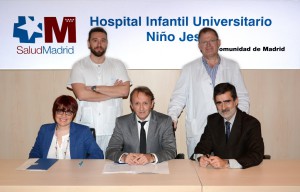
Signing the collaboration agreement took place in the Niño Jesús University Children’s Hospital in Madrid. Seated, left to right, Claudia Tecglen, President of Living with Spasticity (Convives con Espasticidad); José Carlos Lanuza, Director of the Niño Jesús Biomedical Foundation; and Xavier Cortés, Director of the Ramon Molinas Foundation. Standing, left to right, Sergio Lerma, principal researcher and physiotherapist at Niño Jesús Hospital and Ignacio Martínez, traumatologist and orthopaedic surgeon at Niño Jesús Hospital.
Sergio Lerma, principal researcher on the project has confirmed that “it’s fundamental to complete the comprehensive treatment which is offered to these patients with new alternatives which permit them to retain their autonomy for the longest possible time. Working to achieve the maximum levels of functionality of the body and in the cranial-cervical region is one of the most important clinical challenges”. Although the methodology is the same for everyone, for each patient, an objective and a concrete rehabilitation plan will be created according to their clinical history. “The control of the game, total or partial, will be modulated so that for the patient, the experience of the game will always be positive”, Lerma remarks.
The president of Living with Spasticity (Convives con Espasticidad), Claudia Tecglen, has stated that “despite the fact that we need to be cautious until we obtain the results, we believe that the fact itself that research is being carried out is already very good news for the community of people with spasticity. Moreover, using video games increases the motivation of the participants, as mixing therapy and leisure activities will ensure better results”.
Cerebral palsy is the most common cause of permanent severe physical disability in infancy. In Spain, there are 84,000 people who suffer from cerebral palsy, and the damage which causes it can occur between the foetal stage until four years of life. Often, people with cerebral palsy show deterioration in the limbs, upper body and control of the head, which affects their daily life, communication, breathing and socialising.
More information in Training and research.
Links of interest:
Niño Jesús University Children’s Hospital in Madrid website.